


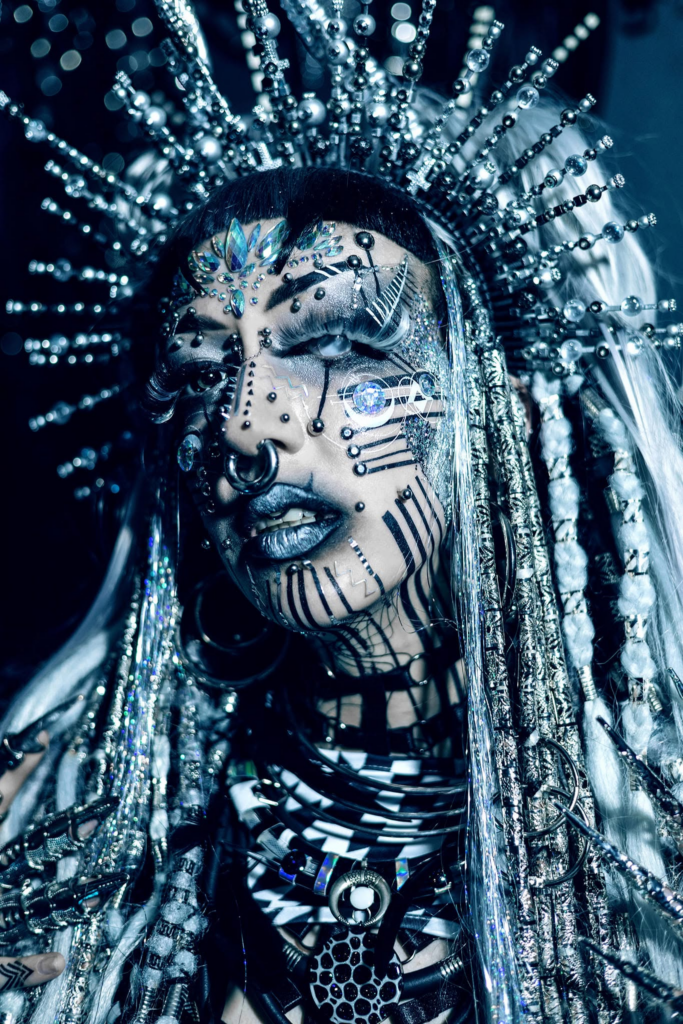
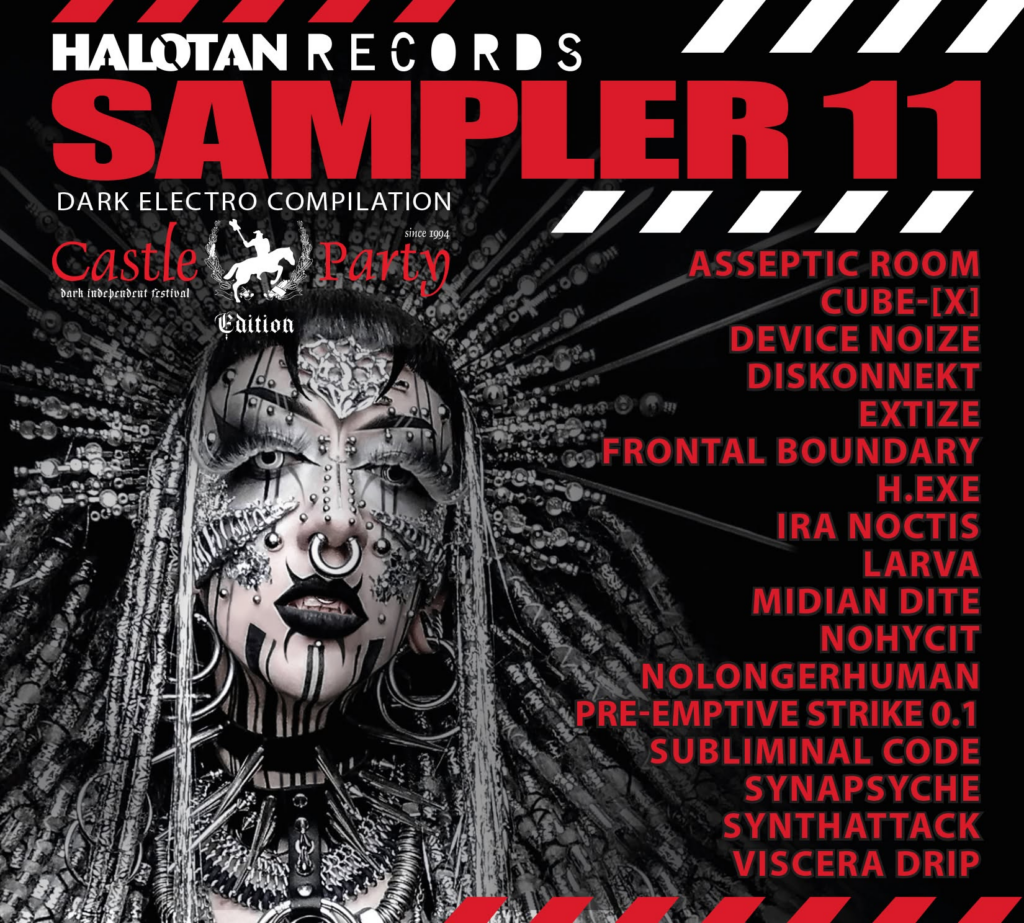
Dark independent culture has never been limited to music alone. The artists who laid its foundations in the late 1970s and early 1980s combined music with visual arts, as well as poetry and theatre. That is why, on Halotan, we aim to engage with artistic fields beyond dark electro itself. Below, we present an interview with a distinctive artist—Arachne Demon: model, performer, and creator of alternative jewelry—whose image will appear on the new Halotan sampler.
Since this interview will be published on a platform focused more on music than lifestyle (and because your image will appear on the new Halotan sampler), I’d like to ask: how important is music to you, and what do gothic or dark independent aesthetics mean to you?
Music is an incredibly important part of my life. It has always been a source of inspiration for me, something that motivates me and allows me to escape everyday problems. Through music, I’ve reached places that opened my eyes to the aesthetic richness of various subcultures, including the gothic one. I’ve attended techno/rave events, fetish, gothic and post-punk parties, metal concerts, tattoo conventions, and fantasy festivals. To be honest, while I don’t identify with any particular subculture, observing each of them and drawing inspiration from what resonates with me has allowed me to develop my own style—a blend of many different influences. What may surprise some people is that I’m not a big fan of gothic music; musically, I’m much closer to techno, rave, and electronic music. However, I do appreciate gothic aesthetics, especially cybergoth, and I still find elements there that inspire me.
What does your typical creative process look like when designing jewelry or accessories? What do you start with: a sketch, material, or mood?
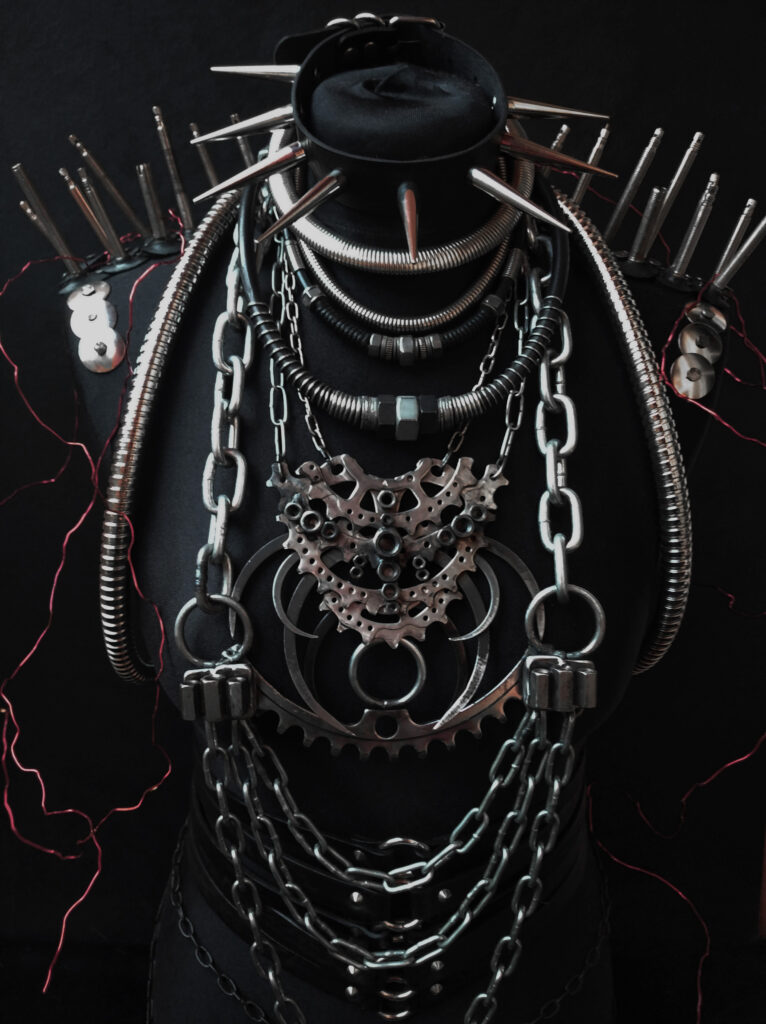
I rarely make sketches—only when I’m working on something really complex. Most often, an idea simply appears in my head, a general outline. Then I look at the materials I have in my workshop and try to combine them in a way that brings my vision to life. Sometimes I completely reverse the design process—for example, I take existing objects, break them down into components, and then use those parts to create something entirely new. The core of my aesthetic is well established—my masters are Giger and Beksiński, filtered through an industrial lens. What attracts me in music also attracts me in art—that’s why rhythm, repetition of motifs, and symmetry are so important to me. Sometimes I disrupt this order with organic forms, similar to how Beksiński did in his paintings.
Do you treat jewelry and accessories more as “applied art,” or as an artistic medium equal to painting or drawing? I’m also asking in the context of your fine arts education.
I don’t see these practices as separate disciplines, and I certainly don’t consider jewelry or accessories to be lower in any “hierarchy of art” than painting or drawing. All of these activities come from the same source in my case, and I approach them with equal commitment. They constantly intertwine, and the skills I develop in one area I apply in the others.
Where did the idea come from to combine creating objects with modeling or performance? It’s almost as if you want to become a work of art yourself.
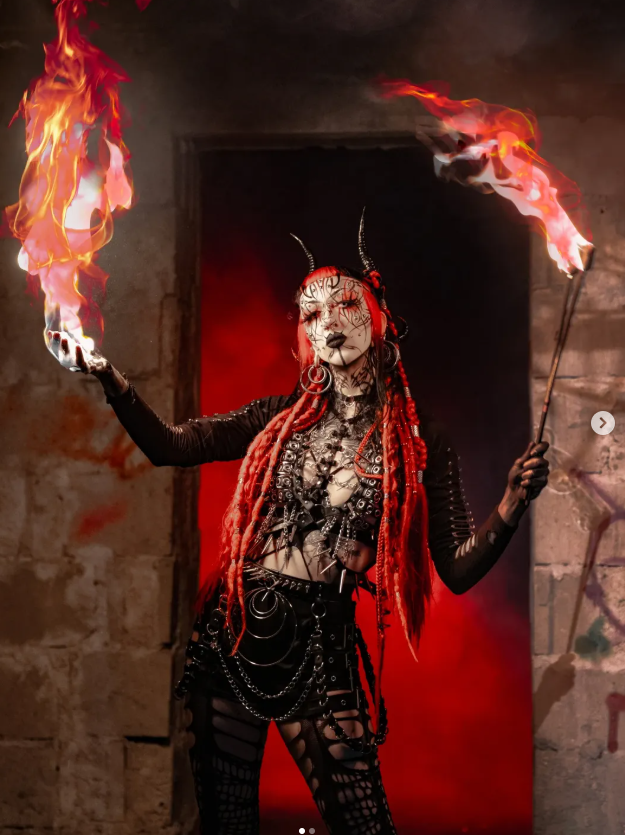
I believe that any space I’m in, and everything around me, can be treated as a space for creating art. The body can be a canvas, and darkness can become a space for painting with light—that’s where my ideas for LED shows and fire performances come from.
How do you prepare for a performance conceptually? Do you create a storyboard or script, or do you rely on improvisation?
It’s improvisation, but built on a preliminary plan and practiced elements. I have certain sequences and movements that I treat like building blocks, which I use to construct a performance. This allows me to respond to specific situations, feel the atmosphere, and create in real time in whatever way feels appropriate in the moment. Performances can take place in very different environments, and I don’t always have the opportunity to familiarize myself with the stage, so the ability to improvise is very useful.
A key question for any artist: how important are craftsmanship and technical precision to you? Is perfectionism more of a driving force or an obstacle? Do you experience burnout when technical aspects overwhelm your creativity?
Perfectionism is largely an obstacle, but at the same time it allows me to refine my work down to the smallest details. Unfortunately, I often struggle to start larger projects because I have an unrealistic vision of how incredible the final result should be. I would say perfectionism is a double-edged sword that I often end up turning against myself. I experience something like horror vacui—every empty space must be filled, which is visible in my designs, styling, and makeup. I don’t really experience burnout, but sometimes the technical aspects of my work do frustrate me, because I’m not always able to fully achieve what I originally envisioned.
Is there a difference between how people perceive your work in real life versus online?
Online, the reception of my work is almost entirely positive. In real life, it varies. In artistic or subcultural spaces, people are usually very enthusiastic. However, in more “ordinary” environments—like shops or on the street—I sometimes encounter dismissive comments or even, in extreme cases, open hostility.
Here you can visit Arachne Demon’s socials:
Instagram: https://www.instagram.com/arachne_demon/
oraz https://www.instagram.com/arachne_demon_art/ (alternative jewelry and other creations)
All other platforms here: https://linktr.ee/arachne_demon